
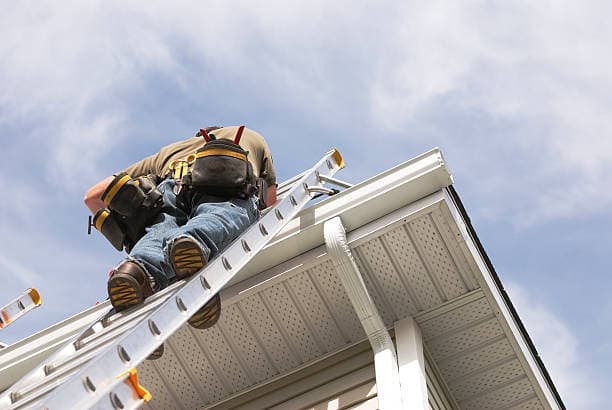
You should repair soffits when the damage is small and isolated, and replace them when the panels are warped, rotted, repeatedly detached, or showing widespread moisture damage. If you are trying to decide on When Should You Repair or Replace Soffits?, the biggest clue is whether the problem is limited to one area or whether the entire soffit assembly is failing.
For matching local service options, see gutter installation port charlotte fl.
Soffits do more than cover the underside of the roof edge. They help protect the eaves from moisture, support attic ventilation, and create a finished barrier against pests and debris. When they start to fail, the problem is often not just cosmetic. Water can reach the roof edge, fascia can begin to soften, and the attic can become more vulnerable to heat buildup, humidity, and insect entry. That is why soffit damage should be treated as a roof edge issue, not just a trim issue.
How to Decide Between Repair and Replacement
The simplest way to decide is to look at the extent, cause, and pattern of the damage. A small repair is usually appropriate when the issue is localized and the surrounding materials are still sound. Replacement becomes the better choice when the material has lost its structure or the same area keeps failing after repairs.
Signs that usually point to repair
Repair is often reasonable when you find one or more of these conditions:
- A loose soffit panel in one short section
- Minor rot limited to the edge of a board or panel
- Small water stains that have not spread
- Peeled paint or peeling caulk around one joint
- A damaged connection where the soffit meets the fascia
- A single spot opened by a small pest entry point
Signs that usually point to replacement
Replacement is more likely when you see:
- Warping across several panels
- Soft, spongy, or crumbling material
- Rot that spreads beyond one small section
- Panels that keep coming loose after repairs
- Moldy or waterlogged material
- Damage across multiple eaves or roof edges
- Repeated staining after rain or storms
A practical rule for homeowners
If you can point to one damaged area and the rest of the soffit system looks stable, repair is usually the first option. If the damage is showing up in several places, or if the same spot has failed more than once, replacement is often more cost effective over time because it addresses the underlying deterioration instead of the symptom.
Why moisture changes the decision
Moisture is the biggest factor. Once soffit material absorbs water long enough to rot, swell, or support mold, the issue is no longer surface deep. Wet or moldy building materials are generally poor candidates for cleaning alone, especially if the structure has softened. That is why water stains, peeling paint, and minor sagging should be viewed as warning signs rather than just appearance problems.
How storm damage affects the choice
In Southwest Florida, storm exposure changes the calculation. Heavy rain, wind driven rain, and hurricane conditions can push water into roof edge details and loosen soffit panels. Coastal homes also face stronger wind uplift and repeated moisture exposure, which can make a repair short lived if the surrounding assembly has already been weakened.
If a storm blew off a section, bent the material, or allowed repeated leaks at the eaves, replacement may be the more durable option. In these cases, you are not only replacing a panel. You are restoring the protective barrier at a vulnerable roof edge.
When ventilation or pests are part of the problem
Soffits are often tied to attic ventilation. If vents are blocked, crushed, or damaged, the attic may not breathe correctly. A small vent defect can sometimes be repaired. But if the venting system is failing across multiple bays, replacement is usually the better call.
Pest entry is another issue. Small openings may be sealed, but if pests have damaged the material or enlarged the opening, the repair often needs to be paired with soffit replacement in the affected area. The key question is whether the soffit still performs its job of protecting the attic and roof edge.
Inspection timing matters
The best time to inspect soffits is after heavy rain, strong wind, or any visible roof edge problem. Homeowners should also check for:
1. Sagging or uneven lines at the eaves 2. Staining on exterior walls near the roof edge 3. Musty odors in the attic 4. Insects or rodents near the roofline 5. Bubbling paint or soft wood near the fascia
These signs often point to a hidden moisture problem, even when the soffit damage looks minor from the ground.
Repair versus replacement at a glance
| Condition | Repair Usually Fits | Replacement Usually Fits |
|---|---|---|
| Damage location | One small area | Multiple areas or repeated failures |
| Material condition | Solid and dry | Soft, warped, or rotted |
| Moisture history | Isolated stain or brief leak | Ongoing water intrusion or widespread staining |
| Storm impact | Minor loosening | Wind damage, missing panels, or deformation |
| Pest impact | Small opening | Enlarged damage or repeated intrusion |
| Long term outlook | Stable after fix | Unreliable after previous repairs |
How soffits connect to the rest of the roof edge
Soffit damage rarely happens in isolation. It is often tied to fascia issues, gutter overflow, roof edge leaks, or blocked attic ventilation. That is why it helps to understand the broader drainage system around the home. If gutters are overflowing or leaking at the edge, moisture can reach the soffit repeatedly and undermine both the trim and the wood behind it. A good place to start reading is why gutters matter, because roof edge drainage and soffit durability are closely related.
What Homeowners in Coastal Southwest Florida Should Watch For
Homes in North Port, Sarasota County, Charlotte County, and nearby coastal areas face a tougher environment than many inland homes. Heat, humidity, frequent rain, and wind driven storms all put pressure on the roof edge. That does not mean every damaged soffit needs full replacement, but it does mean homeowners should be quicker to investigate signs of failure.
Local conditions that push the decision toward replacement
Replacement becomes more likely when:
- Storms have repeatedly lifted or loosened the panels
- Moisture keeps returning after repairs
- Fascia boards are also deteriorating
- The soffit vents are blocked or broken in several sections
- The damage is widespread along exposed roof edges
- The home has ongoing attic moisture or mold concerns
Local conditions where repair may still be enough
Repair may be enough when:
- A single panel was damaged by a branch or minor impact
- One corner shows early peeling paint but the wood is still firm
- A small section has come loose without other signs of decay
- The problem is clearly linked to a seal failure that has not spread
Questions to ask during an inspection
Before deciding, ask:
- Is the damage limited to one area?
- Is the material still firm and dry?
- Has water reached the wood behind the soffit?
- Is there evidence of repeated leaks?
- Are the vents still open and functional?
- Did a storm cause the problem or reveal an older issue?
A simple homeowner checklist
Use this checklist after a storm or when you notice a roof edge issue:
1. Look for sagging or gaps at the eaves 2. Check for water stains, peeling paint, or soft spots 3. Inspect for pest activity near vents or openings 4. Note whether the problem is isolated or widespread 5. Compare the damaged area to the rest of the soffit system 6. Schedule an inspection if the issue keeps coming back
The bottom line for replacement timing
If the soffit material has become soft, warped, rotted, or repeatedly detached, replacement is usually the better choice. If the issue is limited, dry, and caught early, repair is often appropriate. In Southwest Florida, the threshold for replacement is lower when storms, moisture, and roof edge drainage problems are involved because those conditions can quickly turn a small defect into a recurring failure.
Frequently Asked Questions
How do I know if a soffit problem is cosmetic or structural?
If the issue is only peeling paint or a small loose edge, it may be cosmetic. If the material is soft, sagging, rotted, or pulling away from the roof edge, it is more likely structural and may need replacement.
Can I just repaint damaged soffits?
Repainting can improve appearance, but it does not fix rot, hidden moisture, or structural weakening. If the damage came from water intrusion, the source should be corrected before any finish work.
Do storm damaged soffits always need replacement?
Not always. A small area that was loosened or dented may be repairable. If the storm caused missing sections, warped panels, or widespread water entry, replacement is usually the safer option.
Why do soffits fail near gutters and fascia?
That area is exposed to runoff, overflow, and wind driven rain. If gutters leak or overflow, moisture can soak the roof edge and damage both the fascia and the soffit over time.
Should I inspect soffits myself or hire someone?
You can check for obvious warning signs from the ground or an accessible attic, but visible damage at the roof edge often needs a closer look. If you see sagging, softness, repeated leaks, or storm damage, a professional inspection is a good next step.
Need Help With Your Gutters?
No Leak Gutters handles all gutter installation, repair, and maintenance across Sarasota & Charlotte Counties. Get a free estimate today.
Related Gutter Services
Learn more about the services mentioned in this article.