
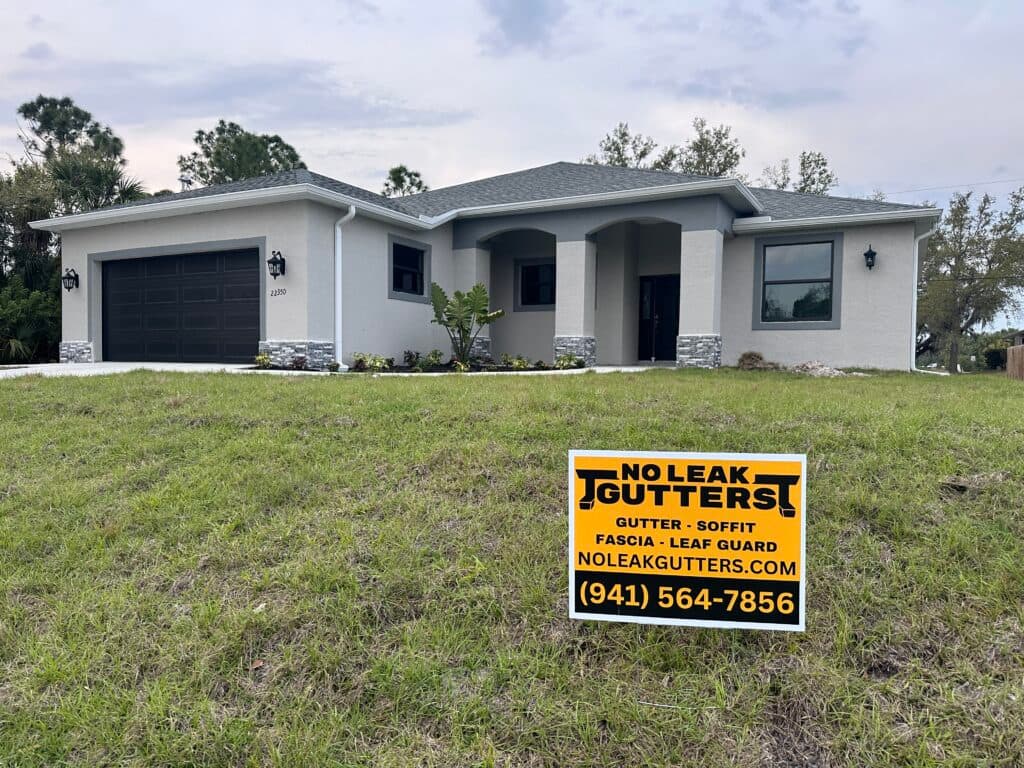
How Many Downspouts Should Gutters Have? The short answer is that there is no single number that works for every home. The right amount depends on roof size, roof shape, gutter size, rainfall intensity, and where the water needs to be discharged. In Southwest Florida, many homes do best with at least two downspouts, while larger roofs, long gutter runs, or roofs with multiple valleys often need more.
The important idea is that downspouts are part of a drainage system, not just add-ons. If the gutters can collect water faster than the downspouts can move it away, the system overflows. If the downspouts are too few or too small, water stays in the gutters longer, spills over the edge, and can pool near the foundation, stain fascia, or erode landscaping. If you are comparing options for North Port gutters, the safest approach is to size the system for your actual roof, not a guess.
A good gutter system starts with one question: how much water does the roof send into each section of gutter during a heavy rain? Once you know that, you can judge whether one downspout per side is enough or whether a longer run needs extra drainage points.
What Determines the Number of Downspouts
Downspout count is driven by capacity. The more roof area that drains into a gutter section, the more water that section has to move. Several factors shape the final setup.
Roof size and projected catchment area
The bigger the roof, the more rainwater it collects. That sounds obvious, but the practical effect is important because a steep or complex roof can concentrate a lot of water into one gutter line. A small ranch home may be fine with only two downspouts if the gutters are divided well. A larger home with multiple roof planes may need four or more.
Roof shape and valleys
Roof valleys are especially important because they send water in a narrow, fast-moving stream. When a valley dumps into a gutter, that spot may need extra capacity or its own downspout nearby. Homes with several valleys, hips, dormers, or intersecting roof lines often need more downspouts than homes with simple layouts.
Rainfall intensity
Southwest Florida receives heavy rain bursts that can overwhelm undersized drainage. Even if a gutter system looks fine in a light shower, it may fail in a tropical downpour. That is why local conditions matter so much. A design that might be acceptable in a drier region may be underbuilt here.
Gutter and downspout sizing
The number of downspouts is tied to the size of the gutters and the downspouts themselves. Larger gutters can carry more water, but they still need enough outlets to empty that water efficiently. A narrow downspout on a long gutter run can bottleneck the whole system.
Where the water can go
Drainage is not only about getting water out of the gutter. It is also about where it goes after that. If the discharge point sends water toward a walkway, slab edge, patio, or tight planting bed, the system may need to be adjusted. In some cases, adding downspouts in better locations is more useful than simply adding more capacity in one place.
Here is a simple way to think about it:
| Roof / gutter condition | What it usually means for downspouts |
|---|---|
| Small roof with short gutter runs | Often 1 to 2 downspouts total |
| Medium roof with moderate runs | Often 2 to 4 downspouts total |
| Large roof or many roof planes | Often 4 or more downspouts |
| Long gutter run without breaks | May need additional downspouts to reduce overflow risk |
| Roof valleys feeding one section | May need a downspout closer to the valley outlet |
| Heavy rainfall area | May need more capacity than a similar roof in a drier climate |
A practical rule of thumb
A useful field rule is about 1 square inch of downspout cross-section for every 100 square feet of roof area. That rule is not a substitute for a full calculation, but it gives homeowners a rough way to see whether a system seems undersized. The key is that the number of downspouts should match the drainage load, not a fixed formula for every house.
How to Estimate the Right Number for Your Home
You do not need to become a drainage engineer to get a useful estimate. You just need to look at the roof in sections and ask how the water travels.
Step 1: Break the roof into drainage areas
Walk around the house and note which roof sections drain into each gutter line. If one side of the house has a long continuous gutter with no break, that section may need more than one downspout. If a valley dumps onto one corner, treat that corner as a high-load point.
Step 2: Look at the length of each gutter run
Longer runs generally need more outlets. Water entering at one end has to travel farther before it can exit, which increases the chance of overflow if the gutter slopes are not enough or if debris slows the flow. A long back gutter with only one downspout in the middle may be more vulnerable than two shorter runs with separate outlets.
Step 3: Check where the highest volume enters
If a roof valley or large upper roof plane feeds a particular area, that area may need a nearby downspout. This is often more effective than spacing outlets evenly without regard to water load.
Step 4: Watch for warning signs during rain
Signs of too few downspouts include:
- Water spilling over the gutter edge
- Splash marks on siding or fascia
- Gutter sections that stay full during heavy rain
- Pooling near the foundation after storms
- Soil erosion under roof edges
- Overflow at roof corners or valley points
Step 5: Compare capacity, not just appearance
A gutter system may look balanced from the ground but still be underperforming. Two homes with the same gutter style can have very different needs based on roof geometry. That is why the answer to how many downspouts gutters should have is always tied to capacity.
Why local conditions matter in Southwest Florida
Heavy rain, wind-driven storms, and long wet seasons make drainage performance more important here than in many other places. Homes in coastal or near-coastal areas may need a more generous setup because rain can arrive fast and in large volumes. If your home has complicated rooflines, consider that the safest layout is usually the one that moves water away fastest, not the one with the fewest visible downspouts.
Why downspout placement matters as much as count
It is easy to focus only on the number of downspouts, but placement matters just as much. Two well-placed downspouts can outperform three poorly placed ones. Good placement helps reduce standing water in gutters, lowers the chance of overflow at corners, and moves runoff away from the areas most likely to be damaged.
A simple homeowner decision guide
Use this quick checklist:
1. Count each distinct roof section that drains into a gutter. 2. Note any valleys that discharge into one spot. 3. Measure or estimate the length of long gutter runs. 4. Look for low spots, overflow marks, or standing water. 5. Make sure discharge points send water away from the house. 6. If the roof is large or complex, assume it may need more than two downspouts.
What code and guidance generally require
There is no universal code-mandated number of downspouts for all gutters. Instead, drainage components are expected to be sized for the roof area they serve and the conditions they discharge into. In simple terms, that means the system has to work for the actual home. The best setup for one house may be too small or too large for another.
When to consider adding another downspout
You may want an extra downspout if:
- The gutter overflows during heavy rain
- One section is much longer than the others
- A roof valley dumps into the gutter
- Water pools near the foundation
- You have staining or erosion under one area
- The home has a large or complex roofline
Frequently Asked Questions
How many downspouts should gutters have on a typical house?
A typical house often has at least two downspouts, but that is only a starting point. Larger roofs, longer runs, and roof valleys often need more.
Can one downspout handle an entire roof?
Sometimes a very small roof section can work with one downspout, but most homes do better with multiple outlets. A single downspout for a large roof usually creates a bottleneck.
Is there a code number for downspouts?
No single code number applies to every home. The system has to be sized to the roof area and discharge conditions, so the required number varies by design.
Do bigger downspouts mean I need fewer of them?
Often, yes, but only up to a point. Larger downspouts can move more water, yet placement and roof layout still matter. A better-sized outlet cannot fix a poor drainage layout by itself.
What is the most common sign I need more downspouts?
Overflow during heavy rain is the most obvious sign. If you also see pooling near the foundation or water spilling at corners, the system may need another outlet or a layout change.
Can I add a downspout without replacing all my gutters?
In many cases, yes. Adding an outlet to an existing system is often possible, but the final solution depends on the gutter size, slope, and where the water needs to discharge.
If you are planning repairs or upgrades, the best answer is usually the one that fits your roof rather than a fixed rule. A careful look at the roof shape, drainage paths, and local rainfall will tell you whether two downspouts are enough or whether the system needs more capacity. For many Southwest Florida homes, the right answer is not fewer downspouts, but smarter placement and enough total drainage to keep water moving away from the house.
Need Help With Your Gutters?
No Leak Gutters handles all gutter installation, repair, and maintenance across Sarasota & Charlotte Counties. Get a free estimate today.
Related Gutter Services
Learn more about the services mentioned in this article.