
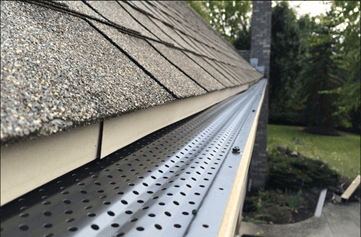
Do Gutter Guards Work in Heavy Rain? The short answer is yes, sometimes, but not always. Gutter guards can reduce clogging from leaves and debris, yet they do not guarantee that water will stay in the gutter during a hard Southwest Florida downpour. In intense rain, the whole drainage system has to keep up with the roof’s runoff volume, and that depends on gutter size, downspout capacity, roof pitch, and how well the system is maintained.
For homeowners, the real question is not whether a guard blocks leaves. It is whether the roof, gutters, downspouts, and discharge paths can move water away from the home fast enough when a storm arrives. If any part of that system is undersized or poorly installed, water can overshoot the gutter, spill at valleys, or back up along the fascia even with guards in place.
How gutter guards behave when rain gets intense
What gutter guards can do well
A properly selected and installed gutter guard can help in several practical ways:
- Keep larger debris out of the gutter trough
- Reduce the frequency of clogs at downspouts
- Lower the amount of routine cleaning needed
- Help water flow more consistently during normal rain
- Reduce the chance that wet leaves will pack into the gutter and hold water
Where heavy rain exposes limits
Heavy rain is where homeowners often learn that a guard is not the same thing as extra drainage capacity. If the roof sends a large volume of water into the gutter all at once, the gutter may not accept it quickly enough, especially on steep roof sections or where water converges from valleys.
Problems that can show up in heavy rain include:
1. Water overshooting the front edge of the gutter 2. Water shooting past the guard profile instead of entering the gutter 3. Overflow at corners and mitered sections 4. Backed up water at downspouts 5. Splashing at sections with poor slope or loose fastening
This is why it helps to think about the entire drainage system. A guard may be clean, but if the gutter is too small, the downspout is too limited, or the runoff is concentrated, overflow can still happen.
Roof shape matters as much as the guard
Roof geometry has a big influence on how a guard performs in a storm. A few common factors matter more than many homeowners expect:
- Steep roof pitch can increase the speed of water flow
- Large roof planes deliver more runoff to a single gutter run
- Valleys concentrate water into one area
- Multiple roof sections feeding one gutter can overload it
- Long gutter runs can struggle if water has far to travel before reaching a downspout
A simple way to judge whether your roof is a candidate
If you are evaluating a home in a rain-prone area like north port gutters, ask these questions:
- Does the roof have valleys that dump a lot of water into one section?
- Are the gutters already overflowing in hard rain without guards?
- Do you have enough downspouts for the roof size?
- Is the gutter slope consistent from end to end?
- Does debris pile up mainly in one area near trees?
What matters most in Southwest Florida homes
Heavy rain is only part of the picture
Southwest Florida weather can be demanding because rain often arrives hard and fast, sometimes with wind and debris. That means gutter guards have to work in conditions that are more stressful than a gentle, steady rain.
In this region, the practical goal is to reduce the chance that water gets behind the gutter, overflows at the fascia, or pools near the foundation. Guards can contribute to that goal, but they are one part of a larger system.
Here are the main factors that affect performance:
| Factor | Why it matters in heavy rain | What homeowners should look for |
|---|---|---|
| Gutter size | Small gutters fill faster | Match gutter capacity to roof runoff |
| Downspout count | Water needs an exit path | More roof area usually needs more outlets |
| Roof pitch | Steeper roofs move water faster | Expect faster runoff on steep sections |
| Valleys | They concentrate flow | These areas often need extra attention |
| Guard style | Some designs handle volume better than others | Performance should match the roof and debris load |
| Maintenance | Even guards need inspection | Check for buildup, loosened sections, and blocked outlets |
Why guard style is not the only deciding factor
Some guard styles are better at shedding debris, while others are better at handling sudden bursts of water. A guard that does well with leaves may still allow overflow if the opening or surface design slows entry during a storm. Another style may admit water more quickly but need more frequent cleaning.
That tradeoff is normal. There is no perfect product for every house, which is why homeowners should focus on fit rather than marketing claims.
When comparing options, think about:
- How much tree debris falls on the roof
- How often storms hit with intense rainfall
- Whether the roof has a steep or complex shape
- How visible the gutter is from the ground and whether access is easy
- Whether the existing gutters are in good condition or already struggling
Installation details can change the outcome
Even a good product can perform poorly if the installation is weak. In heavy rain, small errors show up quickly. Examples include:
- Sections that are not fastened securely
- Guards that interfere with the gutter slope
- Gaps near corners or end caps
- Improper handling around valleys
- Downspouts that are too few or too small for the roof area
Routine inspection still matters
Guarded gutters are not maintenance free. They usually need periodic checks, especially after storms. Homeowners should look for:
- Debris resting on top of the guard
- Leaves packed along valleys
- Overflow marks on fascia or soffit
- Standing water in sections that should drain
- Loose or lifted guard edges
- Downspout discharge that looks weak or backed up
Frequently Asked Questions
Do gutter guards stop overflow in heavy rain?
Not always. They can reduce clogs and help water move more freely, but if the storm is intense enough or the gutter system is undersized, overflow can still happen.
Are some gutter guards better for heavy rain than others?
Yes, but the best style depends on your roof shape, rainfall intensity, and debris load. A guard that works well on one home may not be the best choice on another.
If my gutters overflow with no guards, will guards fix it?
Usually not by themselves. Overflow can be caused by gutter size, downspout capacity, slope, or roof runoff concentration. Guards may help with debris, but they do not automatically add drainage capacity.
Do I still need to clean gutters if I have guards?
Usually yes, though often less often. Guards can reduce buildup, but debris can still collect on top, around valleys, and near downspouts.
What is the most important thing for heavy rain performance?
The full drainage system. Gutter capacity, downspout capacity, roof geometry, and proper installation matter as much as the guard itself.
A practical homeowner checklist
Before choosing guards or deciding whether to keep them, use this simple checklist:
1. Look for existing overflow stains or erosion near the foundation 2. Check whether gutters overflow in the same spots every storm 3. Notice whether valleys dump water into one short gutter run 4. Confirm that downspouts are clear and discharge away from the home 5. Ask whether the gutter size matches the roof area 6. Inspect for sections that sag, pull away, or collect standing water 7. Recheck after a strong storm to see how the system actually performed
The bottom line for storm-prone homes
Gutter guards can absolutely help in heavy rain, but they work best when the rest of the system is ready for the load. In Southwest Florida, that means paying attention to roof design, gutter sizing, downspout placement, and routine inspection. A guard may reduce debris problems, yet it cannot make an undersized or poorly draining system perform like a larger one.
For homeowners, the smartest approach is to treat guards as part of a drainage strategy, not as a fix-all. If your roof already handles water well and debris is the main issue, guards can be a useful upgrade. If your gutters overflow during intense storms, you may need to look beyond the guard and evaluate the entire system.
For matching local service options, see gutter guard installation north port fl.
Need Help With Your Gutters?
No Leak Gutters handles all gutter installation, repair, and maintenance across Sarasota & Charlotte Counties. Get a free estimate today.
Related Gutter Services
Learn more about the services mentioned in this article.