
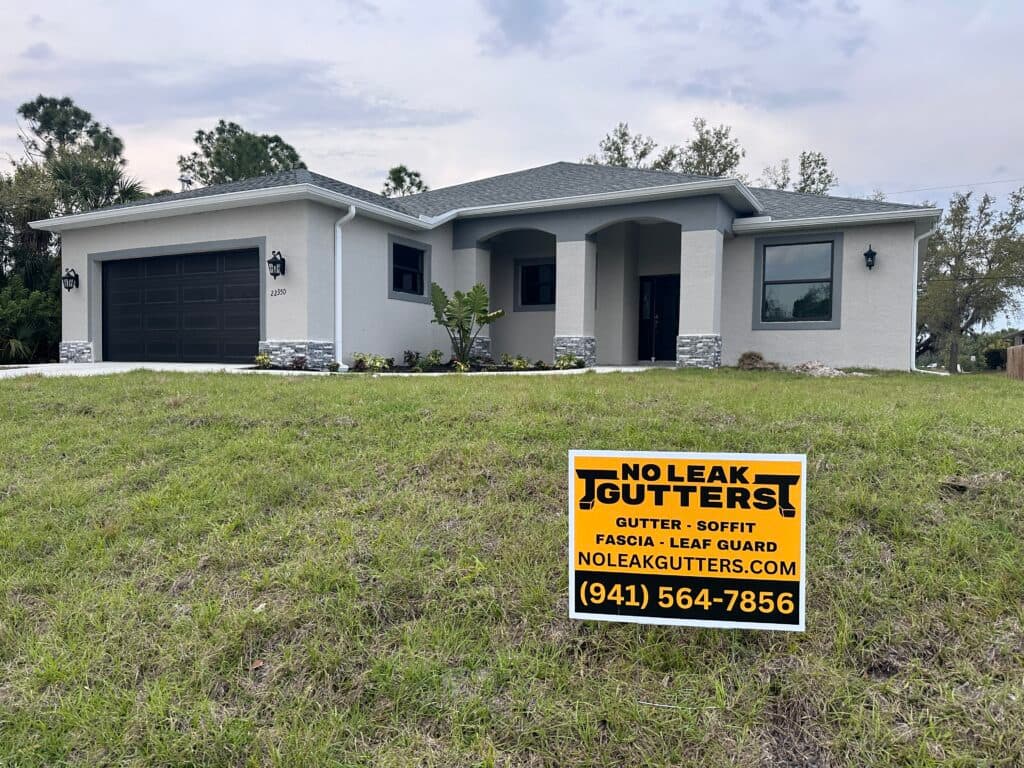
What size downspouts do I need? For many Southwest Florida homes, the short answer is 2x3 downspouts for smaller roof sections and 3x4 downspouts for larger or steeper roof planes that collect more water. The right size depends on the roof area draining to each outlet, the gutter layout, the slope of the system, and how hard it can rain where you live. Florida sizing is flow based, so there is no single diameter that fits every home.
How to choose the right downspout size
Start with the roof area, not just the gutter size
A downspout only works as well as the roof section feeding it. A small roof plane may drain fine through one 2x3 downspout, while a broad or steep section may overwhelm the same outlet during a heavy storm.A simple homeowner rule of thumb used in Southwest Florida is about 300 square feet of roof area per downspout. That is a starting point, not a universal rule. If your home has multiple roof planes, hips, valleys, or long gutter runs, the actual drainage demand can be much higher than it looks from the ground.
Match the downspout to the storm risk
Southwest Florida storms can move water very quickly. That is why larger downspouts are often a better fit for homes with big roof sections, long gutter runs, or areas where overflow would cause problems near patios, walks, or the foundation.For many homeowners, the practical decision comes down to this:
- Use 2x3 downspouts for smaller roof sections with moderate runoff.
- Use 3x4 downspouts where the roof drains a larger area or collects water fast.
- Add more outlets instead of relying on one downspout to handle too much water.
- Check whether the downspout location can discharge water safely away from the home.
Make sure the gutter system can feed the downspout
The best downspout size will not help if the gutter cannot move water to it. Gutters and downspouts should slope toward collection points so water does not pool. In Florida residential systems, the slope requirement is at least 1/8 inch per foot, and gutters must be installed so water drains properly.If a gutter run is too flat, debris collects more easily and water can sit in the channel during heavy rain. If it is pitched correctly, the downspout is more likely to receive a steady flow instead of a backed-up surge.
A practical sizing guide
| Roof section draining to one outlet | Typical downspout choice | Why it may fit |
|---|---|---|
| Small porch, entry, or modest roof plane | 2x3 | Usually enough for limited runoff |
| Medium roof section with average slope | 2x3 or 3x4 | Depends on rainfall, gutter length, and layout |
| Large roof plane, steep pitch, or long run | 3x4 | Better for higher runoff and overflow control |
| Multiple roof planes feeding one point | 3x4 or additional outlets | Reduces bottlenecks during heavy rain |
Signs your downspouts may be too small
Watch for these warning signs after a rain:- Water spills over the gutter edge.
- Downspouts gurgle or back up during heavy rain.
- Water stains appear on fascia or soffit areas.
- Soil washes out near the foundation.
- Splashback shows up on walkways or siding.
- The gutter overflows even when it is clean.
When a larger downspout makes sense
Homes with bigger roof planes
If a single gutter run collects water from a large roof section, a larger downspout is usually the safer choice. This is especially true when the roof area slopes quickly toward one outlet.Homes with multiple stories, broad lanais, or intersecting roof lines often move a lot of water into one part of the system. In those cases, a 3x4 downspout may be a better fit than a 2x3.
Homes with heavy storm exposure
In Southwest Florida, intense rainfall can overwhelm undersized drainage quickly. Larger downspouts can help the system empty faster and reduce the chance of water backing up in the gutter.That does not mean every home needs the largest option. It means the safest size depends on how much water the roof delivers and how fast that water must exit.
Homes where overflow would cause damage
A larger downspout is often worth considering if water would spill near:- entryways
- screened lanais
- landscaped beds
- sidewalks
- driveways
- the home’s foundation
When more downspouts are better than one bigger one
Sometimes the answer is not just a larger outlet. Dividing the roof load between two or more downspouts can improve drainage and reduce stress on the gutter run.That can be a better solution when:
- the gutter run is very long
- the roof has several drainage points
- the fascia line offers room for another outlet
- one section keeps overflowing while the rest works fine
A few things that affect final sizing
Use this checklist before deciding:1. Measure the roof section feeding each outlet. 2. Note how steep the roof is. 3. Count how many gutter runs connect to the same downspout. 4. Look for valleys that concentrate water. 5. Check whether the downspout has a clear, safe discharge path. 6. Consider whether debris tends to collect at that location.
Downspout sizing should fit the real drainage load, not only the look of the house.
Frequently Asked Questions
Are 2x3 downspouts big enough for Florida homes?
They can be, especially for smaller roof sections. For larger roof planes, steep pitches, or areas that get intense runoff, 3x4 downspouts are often the better choice.How many downspouts does my roof need?
That depends on the roof area, the number of gutter runs, and how the water is directed. A common starting point is one downspout for about 300 square feet of roof area, but many homes need more or fewer based on layout.Can I just use the biggest downspout available?
Not always. Bigger is not automatically better if the system is poorly pitched, the discharge location is unsafe, or the gutter layout does not support it. The size should match the roof and drainage path.Why do my gutters overflow even when they are clean?
Clean gutters can still overflow if the downspouts are too small, the gutter slope is off, the roof delivers water too quickly, or too much roof area drains to one point.Should I size my downspouts the same as my gutters?
Not necessarily. Gutter size, slope, roof area, and outlet placement all work together. A properly designed system may use larger downspouts where the roof load is highest and smaller ones where runoff is lighter.If you are trying to decide whether your home needs a better drainage layout, it also helps to understand why gutters matter for roof protection.
For matching local service options, see gutter installation north port fl.
Need Help With Your Gutters?
No Leak Gutters handles all gutter installation, repair, and maintenance across Sarasota & Charlotte Counties. Get a free estimate today.
Related Gutter Services
Learn more about the services mentioned in this article.